AI Runs on GTM OSNot the Other Way Around
AI can accelerate execution. It cannot create the executive clarity required to decide where to grow, what to invest in, how to win, and how teams will operate together.
Executive teams still need to make the fundamental business decisions: which markets and ICPs matter most, which offerings create the highest value, how the company will create and convert demand, which GTM motions to prioritize, how customers realize value, and where expansion will come from.
 Strategic Brain
The Strategic Brain Above the Execution Layer
AI can inform executive decisions. It cannot make the tradeoffs, align the leadership team, or be accountable for the outcome.
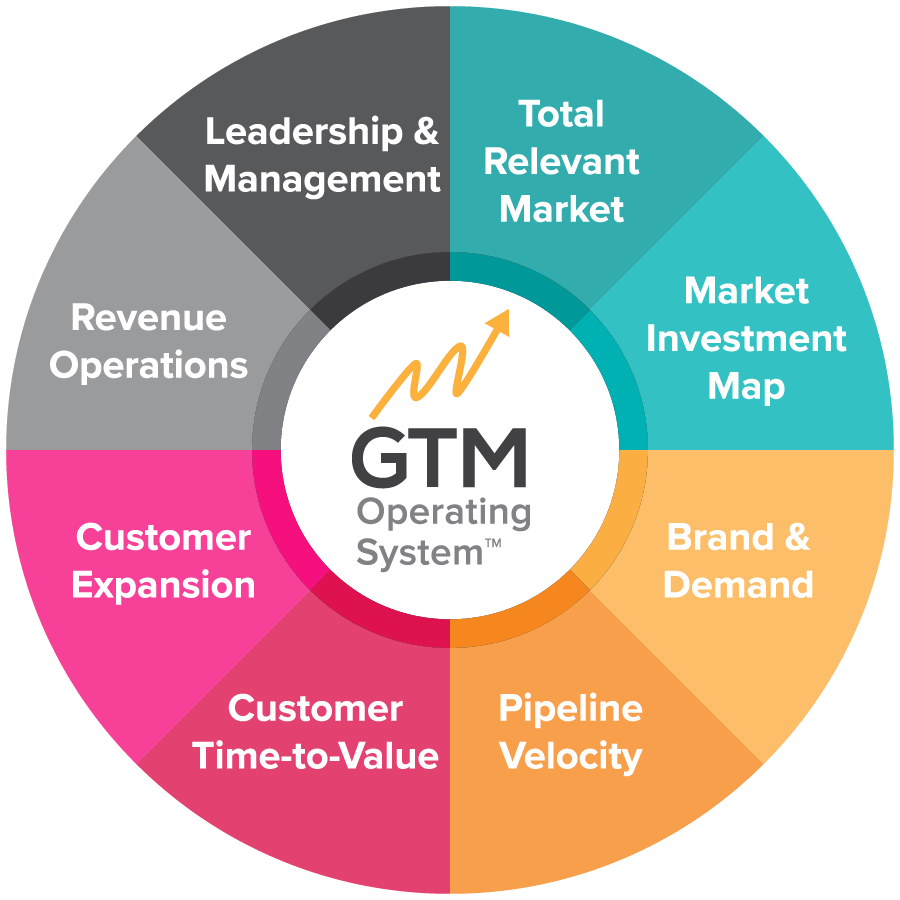
GTM OS sits above AI as the strategic system. It connects market choices, investment priorities, point of view, revenue motions, customer strategy, operating data, and leadership rhythm into one shared model for growth.
Once that system is clear and codified, it becomes the strategic context AI needs to be useful. AI can operate from a trusted source of truth for the company’s ICPs, products, messaging, customer value, GTM motions, ownership, and priorities—instead of fragmented data, outdated documents, disconnected playbooks, and conflicting assumptions across functions.
“AI is the execution layer. GTM OS is the strategic brain.”
AI makes good GTM faster and more scalable. It does not make unclear GTM clear.
This is why AI adoption is not principally a tooling problem. It is a business and leadership problem. Leaders still have to define how customers realize value and expand, resolve cross-functional tradeoffs and ownership, and create the clarity, alignment, and trust required to run the system. Without those decisions, AI can increase activity while making the underlying GTM problems move faster.
The AI Stack Most Companies Get Backwards
Most companies start with tools: they buy copilots, agents, enrichment platforms, automation tools, and AI features inside existing software—then ask teams to find ways to use them. That reverses the proper sequence:
Strategy
Decide where to grow, which customers matter, what to sell, which GTM motions to prioritize, and how customers will realize value.
Operating System
Codify those decisions into shared GTM priorities, revenue motions, ownership, metrics, and operating rhythms.
Data & Context
Create a trusted source of truth for customer, market, product, pipeline, and performance data.
AI
Use AI to analyze, recommend, personalize, automate, and accelerate execution against that shared context.
Human Judgment
Keep leaders accountable for tradeoffs, priorities, relationships, and outcomes.
“AI should inherit strategy—not invent it. When the sequence is reversed, AI becomes another layer of activity. When the sequence is right, AI becomes part of how the business operates.”
Five Expensive AI Mistakes GTM Leaders Make
Automating a Broken Motion
AI can make an inefficient inbound, outbound, partner, product, or customer motion run faster without making it better. If the underlying economics, ownership, or customer experience are broken, more automation simply increases the speed of the problem.
Scaling the Wrong ICP
If leadership has not aligned on who the company is best positioned to serve, AI increases the volume of activity against inconsistent targeting. More accounts. More outreach. More content. Not necessarily more good customers.
Personalizing Without a Point of View
Generating more personalized content is not the same as creating differentiated demand. AI cannot compensate for unclear positioning, weak messaging, or the absence of a strong point of view.
Adding Agents Before Fixing Ownership
An AI agent does not resolve ambiguity about who owns the customer, the handoff, the metric, or the outcome. If people and functions are unclear on ownership, agents can make the workflow more complex rather than less.
Measuring Productivity Instead of Business Impact
More emails sent, content produced, meetings summarized, accounts researched, or workflows automated are activity metrics. The real questions are: Did pipeline quality improve? Did conversion improve? Did customers realize value faster? Did retention or expansion improve? Did cost decrease? Did revenue become more efficient?
“AI magnifies the system it is placed inside. If the GTM system is fragmented, AI can scale the fragmentation.”
AI Makes Each GTM OS Pillar More Powerful
AI has a meaningful role to play within the work of implementing each GTM OS pillar. As the executive team works through a pillar, AI can synthesize relevant business data, customer feedback, market signals, product usage, pipeline activity, and operational performance.
But AI is not a replacement for the pillar work—or for the executive working session. The value of GTM OS comes from bringing leaders together to interpret the evidence, resolve competing priorities, make tradeoffs, and commit to a shared decision.
“AI helps the team see more. GTM OS helps the team decide what matters.”
AI Is Only as Reliable as the GTM Context Behind It
AI cannot operate consistently when different teams have different definitions of ICP, qualified opportunity, customer value, churn risk, expansion, revenue motion, ownership, and success.
If marketing, sales, customer success, product, finance, and operations are each operating from different assumptions, AI inherits those differences—creating a dangerous illusion of highly sophisticated output built on fragmented context.
Why Revenue Operations Is the Anchor
RevOps provides the shared data, definitions, measurement, and feedback loops AI needs to operate against reality rather than departmental assumptions. The goal is not perfect data—the goal is enough trusted context that both people and AI make decisions from the same view of the business.
AI Should Improve Outcomes—Not Just Efficiency
The opportunity is bigger than writing content faster, cleaning lists, summarizing calls, or automating follow-up. The standard is not “What tasks can AI replace?” It is:
“Where can AI improve the business outcome?”
Efficiency matters. But efficiency applied to the wrong work does not create better growth. AI must be cross-functional by nature because it works across the entire customer lifecycle—linking marketing, sales, CS, product, and finance into one system.
AI Should Plug Into the GTM Operating Rhythm
Improve Execution
AI surfaces meaningful changes, risks, opportunities, and recommended actions against the active Revenue Model Playbook—tracking intent spikes, buyer engagement, adoption shifts, or competitive movement.
Improve the Decision Loop
AI helps analyze performance against the GTM Executive Scorecard and identifies where execution is drifting from strategy—asking what changed, why it changed, and which assumptions are no longer true.
Improve the Strategy
At the beginning of each 90-day cycle, AI brings fresh market, customer, product, and pipeline evidence into GTM Planning to refresh the GTM OS on a Slide, update playbooks, and set new priorities.
Keep Humans Where Judgment Matters Most
AI Is Best Suited For:
- Account and contact research
- Buying-committee identification
- Data enrichment & prioritization
- Content drafts & message variations
- Follow-up workflows & triage
- Pipeline & cohort analysis
- Signal detection & anomaly alerts
- Meeting & feedback synthesis
Human Leadership Is Essential For:
- Setting overall business strategy
- Choosing where to invest & what not to do
- Making tough cross-functional tradeoffs
- Shaping the company’s Point of View
- Building trust with executive buyers
- Resolving organizational conflicts
- Exercising high-stakes judgment
- Holding teams accountable for results
What This Looks Like in Practice: GTMee
When you work with a Certified GTM OS Partner, your executive team is not relying on the partner’s experience alone.
You also gain the benefit of GTMee, GTM Partners’ AI agent trained on the full body of GTM Partners IP and designed around the methods, frameworks, and implementation patterns used in GTM OS engagements.
GTMee is not trained on your company’s private data.
Instead, it gives the Certified Partner and executive team a GTM OS-trained intelligence layer they can use throughout the engagement to work from the same frameworks, language, and strategic context.
GTMee can help the team:
The objective is not to replace the executive team or the Certified GTM OS Partner. It is to help both work faster, ask better questions, and stay anchored to the strategic system they are implementing.
“The partner brings judgment and facilitation. GTMee brings the accumulated intelligence of the GTM OS.”
Build the GTM System Before You Scale It With AI
As execution becomes easier to automate, the quality of the decisions behind that execution matters even more. Which customers? Which markets? Which products? Which motions? Which investments? Those are GTM questions—and they still belong to leadership.
“AI raises the ceiling. GTM OS determines the outcome. The companies that win will use AI to accelerate a clear GTM strategy—not as a substitute for one.”
Ready to Build the GTM System AI Can Run On?
A Certified GTM OS Partner can help your executive team clarify the strategy, align the GTM system, identify the right priorities, and determine where AI can create the most leverage.