Customer ExpansionHow else can you upserve your customers?
A CEO’s guide to escaping the acquisition treadmill, targeting high-expansion cohorts, and designing pricing, packaging, and plays that drive Net Revenue Retention above 115%.
 GTM OS™ Framework
Acquiring a new customer costs 5 to 7 times more than expanding an existing one. Yet in most B2B organizations, 90% of go-to-market budget, executive attention, and marketing headcount is dedicated strictly to winning new logos.
When a company focuses solely on top-of-funnel acquisition while treating post-sale expansion as an afterthought, Net Revenue Retention hovers around 90% to 100%. The business is trapped on an acquisition treadmill — constantly spending expensive capital to replace the revenue that leaks out the back door.
The highest-performing B2B enterprises in the world do not grow by acquisition alone. They grow because their installed base compounds. They achieve 115% to 130%+ NRR, meaning their customer base grows significantly each year before a single new deal is signed.
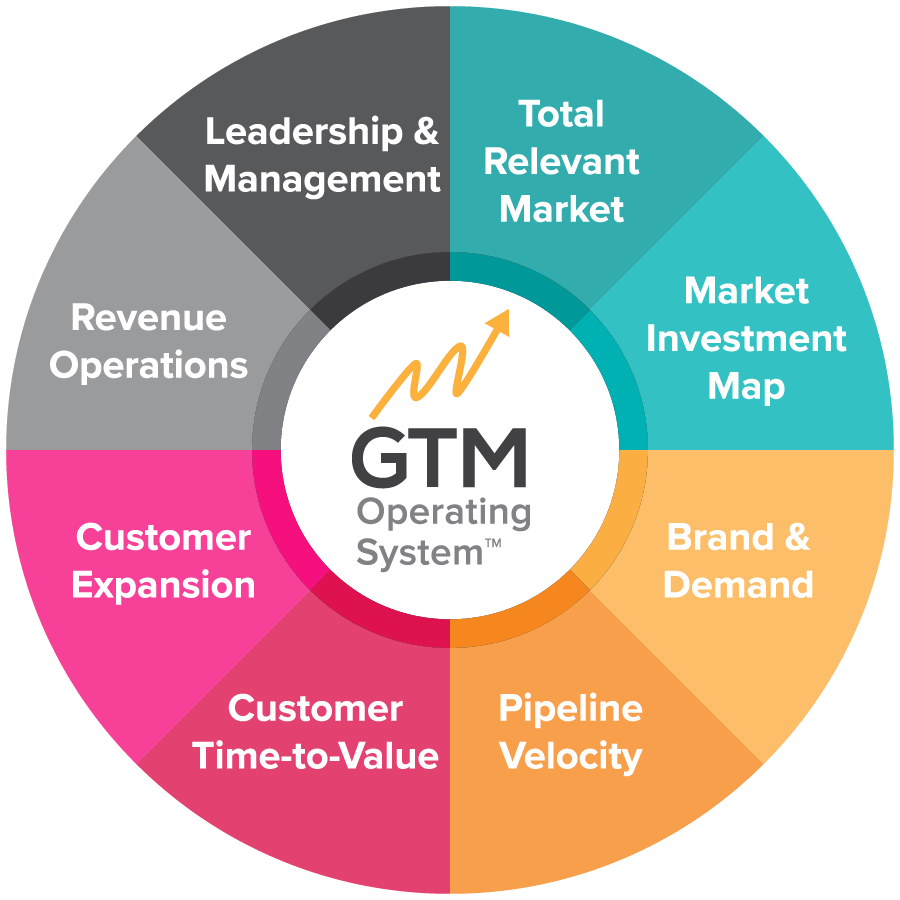
Pillar 6 of the GTM Operating System — Customer Expansion — is where you build that compounding revenue engine.
The Acquisition Treadmill: Why New Logos Alone Cannot Scale a Business
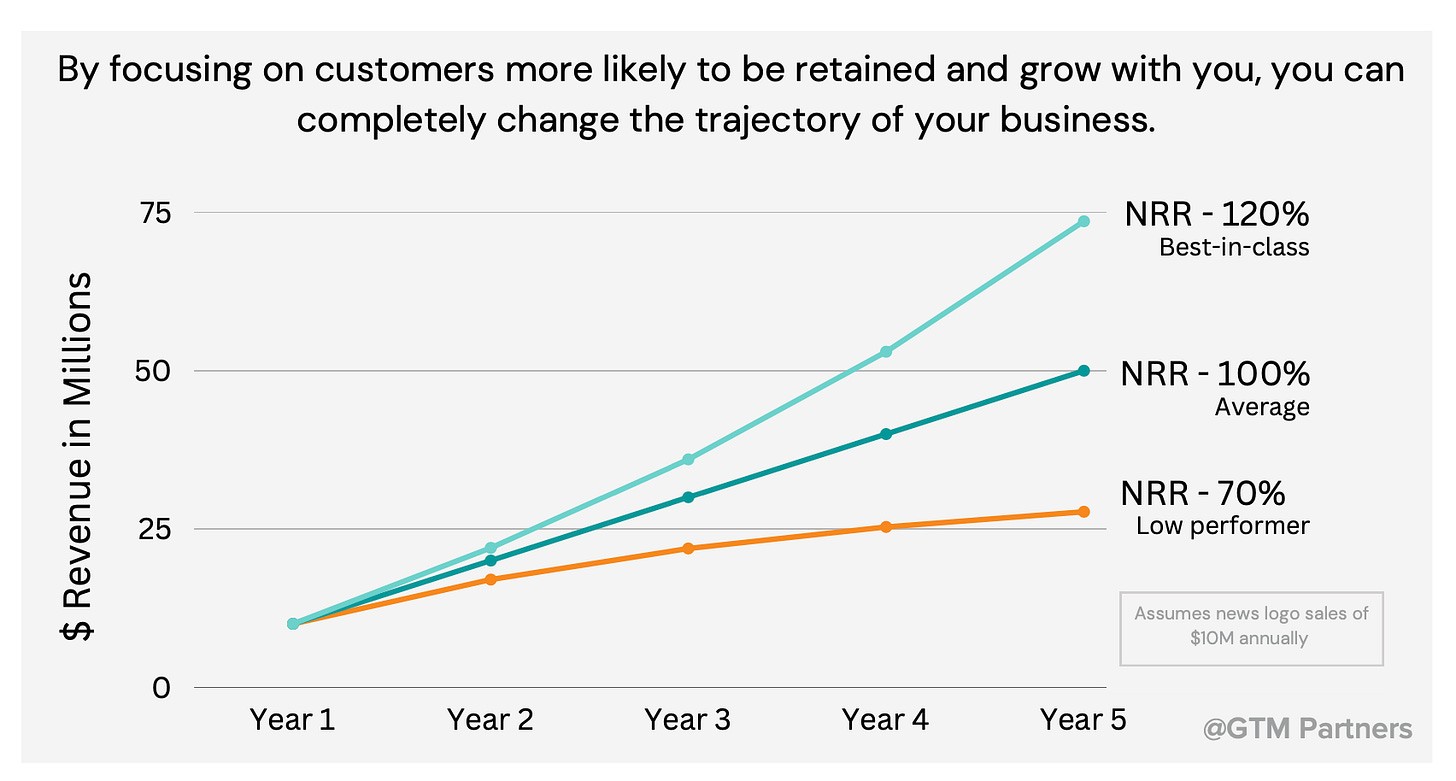
Consider two competing B2B companies that generate the exact same $10M in new customer acquisition over a year:
Company A (90% NRR)
With a $20M baseline and 90% NRR, they lose $2M to churn/contraction. Adding $10M in new logos yields $28M ARR (40% net growth).
Company B (125% NRR)
With the same $20M baseline and 125% NRR, their existing base expands by $5M. Adding $10M in new logos yields $35M ARR (75% net growth).
Same acquisition spend, same sales headcount — yet Company B generates nearly double the net growth because their customer base compounds.
“A company with 120% NRR grows even if marketing and sales go completely silent. That is the power of compounding customer momentum.”
The Core Diagnostic Question: “How Else Can You Upserve Your Customers?”
In the GTM Operating System, Pillar 6 shifts the mindset from transactional “upselling” to strategic Upserving.
Upselling is pushing extra features to hit a quarterly quota. Upserving is identifying where a successful customer is hitting their next growth constraint and proactively providing the advanced capability, service tier, or integration needed to solve it.
Customer Expansion is not an uncoordinated effort left to individual Customer Success Managers. It is an intentional, account-based GTM motion governed by data, packaging, and executive plays.
Reframing the Growth Equation
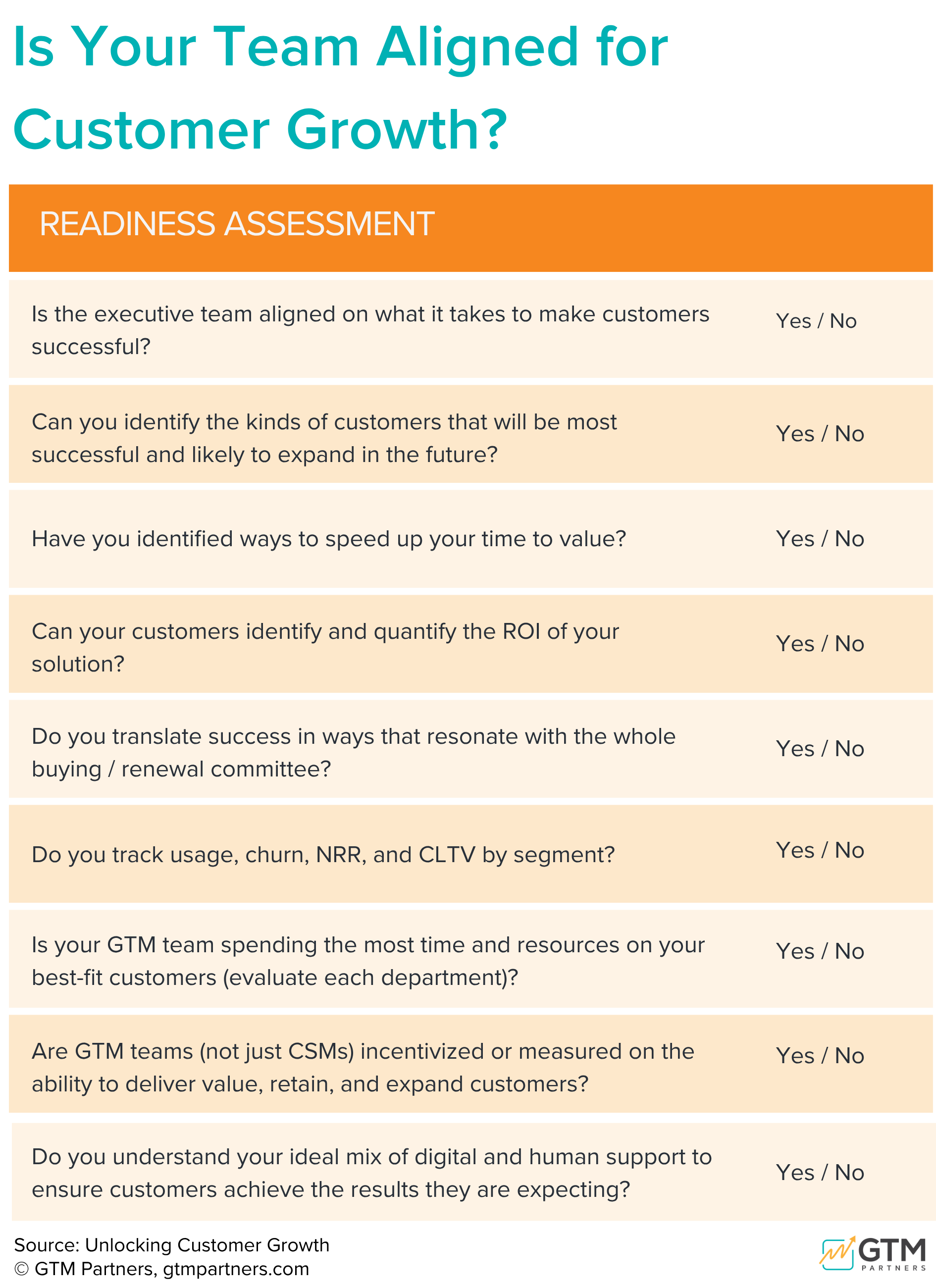
Key Questions to Shift to a Customer Driven Growth Strategy
Unlocking Customer Growth Guide
Download the complete executive PDF guide on turning retention into an intentional, company-wide expansion operating model.
The 4 Core Mechanisms of Customer Expansion
Sustainable expansion occurs across four distinct operational pathways:
1. Volume & Usage Expansion
Growing seat licenses, data consumption tiers, API calls, or transaction volume as the customer’s organization scales.
2. Cross-Selling Add-On Modules
Introducing complementary products and capabilities identified in the Market Investment Map (Pillar 2) to existing accounts.
3. Upserving (Outcome Upgrades)
Upgrading accounts to strategic advisory services, dedicated infrastructure, enterprise security SLAs, or managed services.
4. Land & Expand (Multi-Division)
Expanding from a single regional team or subsidiary division into other business units and international entities across the parent enterprise.
The Customer Expansion ICP & Cohort Scoring
Not every existing customer is a candidate for expansion. Attempting to upsell an account that is experiencing friction or has low organizational maturity damages customer trust.
In the GTM Operating System, leadership runs the installed customer base back through the TRM and ICP Scoring Rubric (Pillar 1) to identify high-expansion cohorts:
- • High-Expansion Cohort (+5 Accounts): High platform adoption, verified ROI, multi-department presence, and strong executive sponsorship.
- • Maintain / Baseline Cohort (+1 Accounts): Stable, happy, and renewing, but limited organizational capacity to expand contract size.
- • At-Risk / Do Not Expand (-3 to -5 Accounts): Active friction or low utilization. All resources must focus on Time-to-Value (Pillar 5) before expansion is considered.
Pricing & Packaging for Friction-Free Expansion
Expansion is frequently blocked not by customer hesitation, but by poor Pricing & Packaging architecture.
If your pricing model locks customers into rigid, all-or-nothing tiers, upgrading requires complex contract renegotiations that invite procurement pushback.
Best-in-class B2B pricing ties expansion to natural value metrics (e.g., volume of transactions, active pipeline managed, or modular feature packs) that automatically scale contract value as the customer achieves greater business success.
The Compounding Economics of NRR > 115%
In the capital markets, Net Revenue Retention is the single biggest multiplier of software and recurring revenue valuation multiples.
A business with 120% NRR is valued at significantly higher multiples than a company with 95% NRR because every cohort acquired adds permanent, compounding baseline revenue. Customer expansion is the most capital-efficient growth lever available to the executive team.
How Companies Implement Customer Expansion
Customer Expansion is a synchronized commercial effort between Account Management, Customer Success, Product Marketing, and Executive Leadership.
Working with a Certified GTM OS Partner helps leadership audit the customer base, identify highest-potential expansion cohorts, redesign pricing tiers, and install the Account-Based Expansion (ABX) plays that drive NRR above 115%.
Engage a Certified GTM OS Partner for Pillar 6 (Customer Expansion):
- • Installed Base Cohort Audit: Score your active accounts against TRM criteria to isolate high-expansion candidates.
- • Pricing & Packaging Redesign: Create modular packages and natural value metric scaling that unlock expansion.
- • Account-Based Expansion (ABX) Plays: Deploy multi-threaded expansion campaigns into key enterprise accounts.
- • NRR Governance & RevOps Instrumentation: Track and manage expansion velocity and pipeline inside your operating dashboard.
What Executive Teams Say About Customer Expansion
Perspectives on how the Customer Expansion pillar helps teams grow existing accounts through value-based pricing, expansion motions, and better visibility into customer adoption and outcomes.
"The GTM OS work forced us to look at our business through the lens of revenue motions instead of individual services. We realized some of our offerings weren't separate plays at all — they were part of one motion where we land customers with one solution and expand them into larger engagements. Once we saw that clearly, it changed how we think about growth."
"The Customer Expansion work made something very clear to us — if you price at the transaction level, you train the market to negotiate price. Every buyer immediately wants to discount the unit cost. That's how you end up commoditized. But when you anchor pricing to the value you create — efficiency, scale, operational improvement — the conversation shifts. Suddenly you're not negotiating price, you're expanding value inside the customer."
"We tried to scale customer success with digital programs, but it didn't work. The GTM OS work helped us see why — we didn't have the telemetry to measure adoption or prove value. You can't scale customer outcomes without that visibility."
Ready to Unlock Compounding Growth From Your Installed Base?
Connect with a Certified GTM OS Partner to audit your customer base, optimize pricing and packaging, and build the expansion plays that drive NRR above 115%.