
Customer Time-to-ValueWhat’s your ROI in the customers’ mind?
A CEO’s guide to stabilizing Gross Revenue Retention (GRR), diagnosing the 5 D’s of customer friction, and engineering rapid time-to-value across onboarding and adoption.
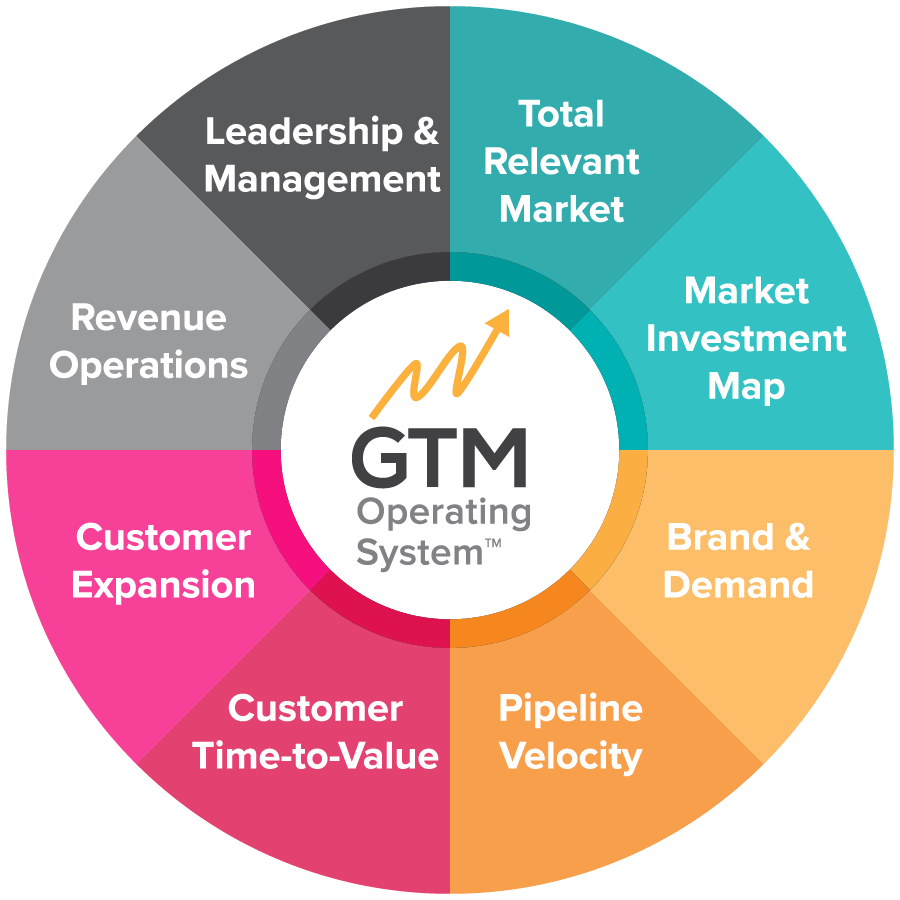 GTM OS™ Framework
In traditional enterprise sales thinking, closing the contract is treated as the finish line. The deal is signed, the sales gong rings, commissions are paid, and the customer is handed over the wall to onboarding.
In modern subscription and recurring revenue businesses, the sale is merely the starting line.
If your customers take four months to complete onboarding, encounter silent delays, or discover that the product reality does not match the sales demo, churn is already guaranteed. The customer simply waits until the renewal window to make it official.
Pillar 5 of the GTM Operating System — Customer Time-to-Value (CTV) — is where companies design the customer journey to deliver rapid, indisputable business ROI.
Gross Revenue Retention (GRR): The Foundation of Sustainable Growth
Every executive team wants high Net Revenue Retention (NRR > 120%). But in the GTM Operating System, there is a fundamental law of customer economics:
You cannot build a durable expansion engine on top of a leaky retention base.
Gross Revenue Retention (GRR) is the primary health metric of Pillar 5. If your GRR is below 85–90%, launching expansion, upsell, and cross-sell initiatives (Pillar 6) will fail. Customers who are struggling to realize the initial value they purchased will not buy more products.
Fixing GRR is not about running frantic save-desk campaigns 60 days before contract expiration. Fixing GRR requires engineering faster Time-to-Value in the first 90 days of the relationship.
The Core Diagnostic Question: “How Quickly Do Customers Realize Value?”
Pillar 5 forces the executive team to define and measure the time it takes for a customer to achieve their first verified business win.
Technical deployment is not Time-to-Value. Provisioning user licenses, configuring single sign-on, or completing an onboarding checklist does not constitute value.
Time-to-Value is achieved only when the economic buyer and customer champion experience the specific business outcome they signed the contract to achieve.
The 5 D’s of Customer Friction
Customer churn is rarely caused by a single catastrophic event. It is the cumulative result of negative friction moments. In the GTM Operating System, these moments are classified into The 5 D’s — the proven path to failure:
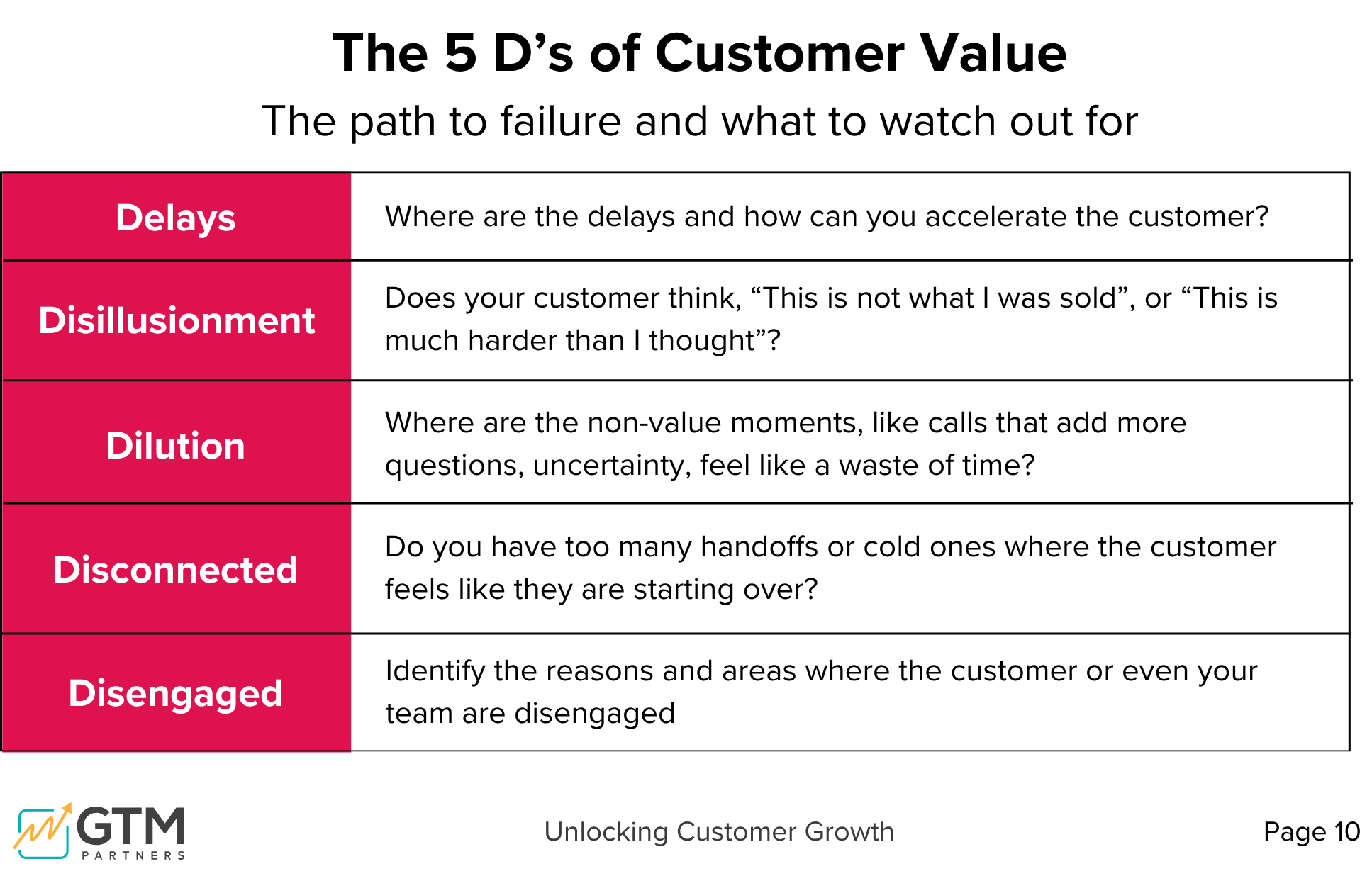
Delays
Moments of unmanaged waiting, internal handoff bottlenecks, delayed system access, and post-sale silence where the customer feels time is running out while nothing is moving.
Disillusionment
The gap between sales promises and operational reality: “This is not what I was sold” or “This is much harder than they claimed.” It lives in the customer’s mind long before showing up in churn metrics.
Dilution
Non-value interactions, bureaucratic status meetings, unreadable dashboard reports, and QBRs that fail to deliver executive insight. When customers defer check-in meetings, it is a Dilution signal.
Disconnected
Cold handoffs where the customer has to re-explain their business context to implementation or CS. Every time a customer feels like they are starting over from scratch, trust evaporates.
Disengaged
The quiet breakdown where customer sponsors stop attending reviews, responses become sporadic, and the vendor team quietly deprioritizes the account. The relationship fails without conflict.
Customer Value Mapping: Designing the “To-Be” Experience
To eliminate the 5 D’s, executive teams use Customer Value Mapping to document the current “As-Is” journey and design the ideal “To-Be” experience.
Instead of evaluating internal departmental handoffs, Value Mapping examines the journey strictly through the buyer’s eyes:
- • Pre-Close Alignment: Bringing implementation leads into final sales discovery to eliminate cold handoffs.
- • Expectation Calibration: Setting transparent milestones during onboarding so hard implementations do not breed disillusionment.
- • Outcome-Based Reporting: Replacing generic usage metrics with the three business metrics the buyer care about.
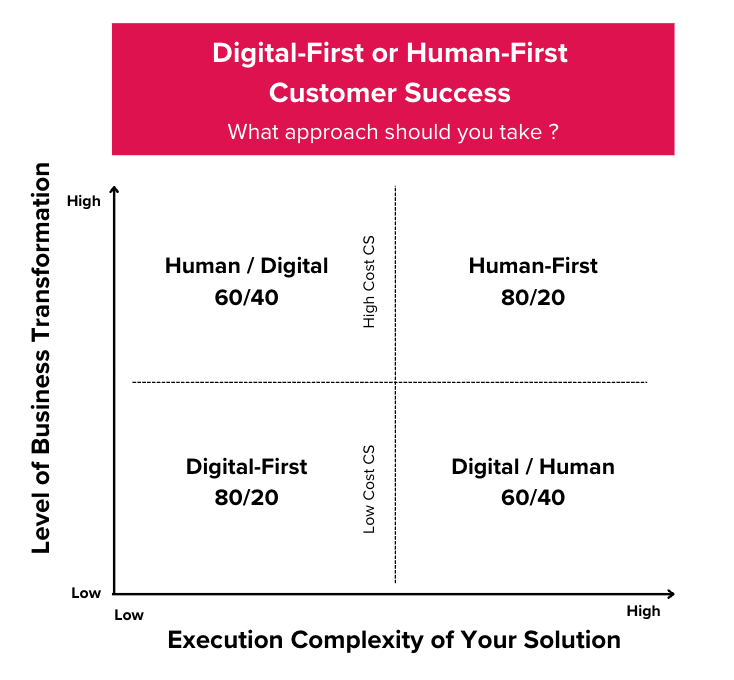
Revenue Grading: Shifting from Churn Firefighting to Growth Potential
One of the most destructive traps in post-sale operations is reactive churn firefighting. Customer Success teams spend 80% of their operational hours chasing unhappy, disengaged customers in the final 60 days before contract renewal—diverting critical attention away from accounts that have high expansion readiness.
Created by Bryan Brown and GTM Partners, Revenue Grading provides a diagnostic framework to categorize the entire customer portfolio by dollar volume ($ ARR) and logo count across three distinct health grades:
Renew & Expand
High product adoption, verified ROI, and strong executive sponsorship. These accounts represent your compound growth engine and should receive proactive expansion playbooks.
Renew Only
Steady, reliable product utilization and predictable retention, but limited organizational appetite or scope for upsell. These accounts protect baseline GRR.
Churn Candidates
Low usage, unresolved 5 D’s friction, or severe dissatisfaction. Triage is required to isolate non-ICP deals from fixable product/onboarding breakdowns.
The ICP Overlay: Triage Before You Triage
When analyzing Grade C accounts, leadership must cross-reference each account against the company’s Total Relevant Market (TRM / Pillar 1):
Case Model: $250M Industrial Manufacturer Portfolio Comparison
To understand the mathematical impact of Revenue Grading on Net Revenue Retention (NRR), consider a $250M revenue industrial manufacturing enterprise. When customer portfolios suffer from delayed time-to-value and unaddressed friction, Grade C accounts balloon, holding NRR at 90%. When the company operationalizes proactive value milestones and expansion pathways, Grade A accounts surge to 60% of ARR, propelling NRR to 120%:
$250M ARR at 90% NRR
Trapped in reactive churn firefighting & heavy Grade C drag
$250M ARR at 120% NRR
Engineered for proactive adoption, expansion, and high GRR
“Stop chasing unhappy customers at the 11th hour. Use Revenue Grading to identify your Grade A accounts on Day 30 and deploy dedicated expansion playbooks while they are realizing peak value.”
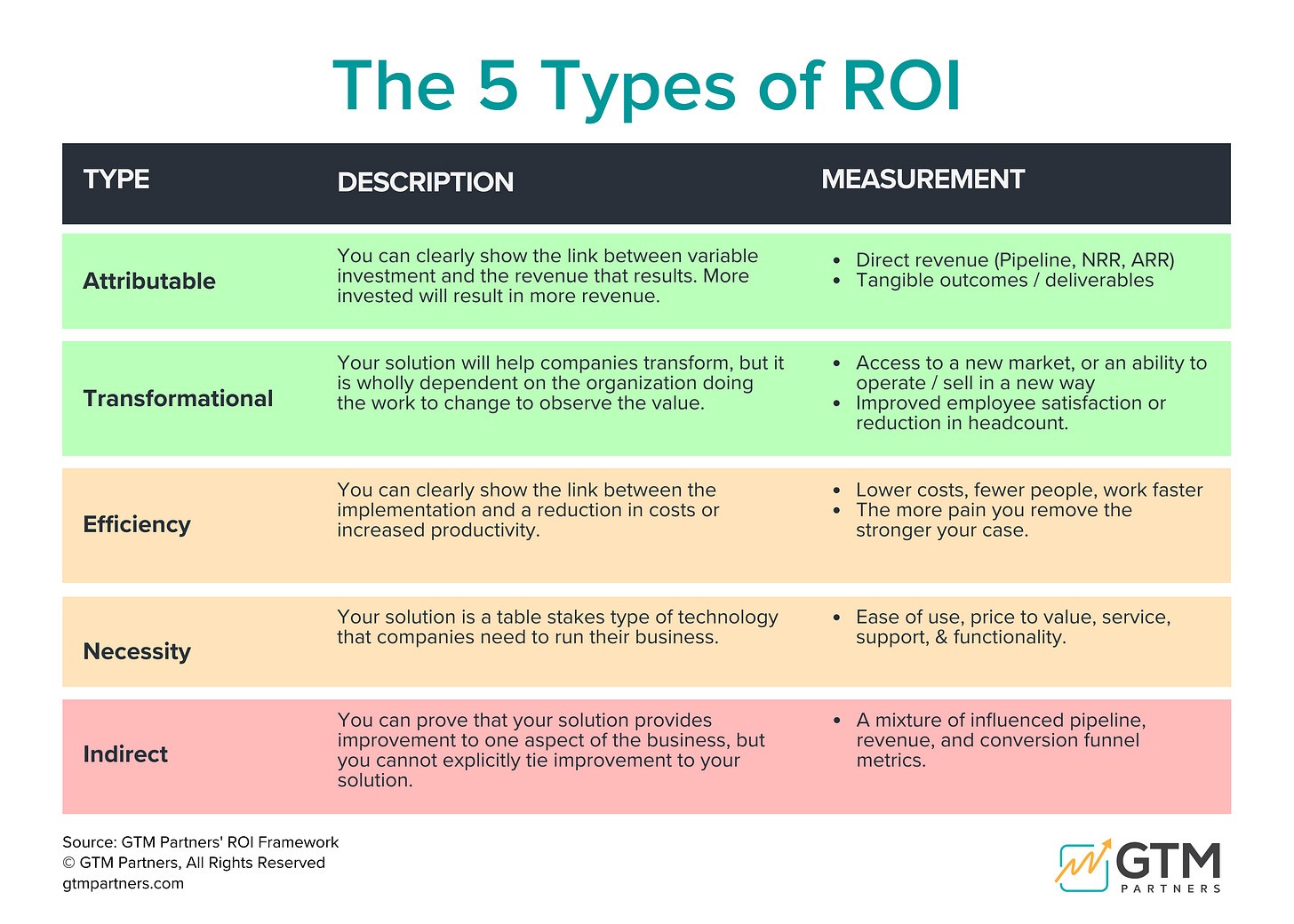
Proving Value: The 5 Types of ROI
Customers renew when their internal champion can easily justify the investment to the CFO. GTM Partners categorizes value into The 5 Types of ROI:
You can clearly show the link between variable investment and revenue that results (Pipeline, NRR, ARR, tangible deliverables).
Helps companies transform, access new markets, or operate in new ways (dependent on the organization adopting change).
Clearly shows the link between implementation and cost reduction, fewer labor hours, or increased productivity.
Table stakes technology, compliance, security governance, and functionality companies need to run their business.
Provides improvement to aspects of the business, but cannot be explicitly isolated or tied directly to the solution alone.
Engineering Moments of Value in the First 90 Days
The first 90 days determine the lifetime of the customer account. Best-in-class B2B organizations deliberately engineer three distinct value milestones:
How Companies Implement Customer Time-to-Value
Customer Time-to-Value is not just a Customer Success project — it is a cross-functional alignment sprint between Sales, Onboarding, CS, and Product.
Working with a Certified GTM OS Partner provides the objective facilitation required to map the customer journey, diagnose the 5 D’s, and build the post-sale roadmap that protects Gross Revenue Retention.
Engage a Certified GTM OS Partner for Pillar 5 (CTV):
- • 5 D’s Customer Friction Audit: Surface and eliminate delays, disillusionment, dilution, disconnection, and disengagement.
- • Customer Value Mapping: Redesign the sales-to-delivery handoff and onboarding milestone sequence.
- • ROI Persona Modeling: Build champion-ready ROI proof templates to defend renewals.
- • GRR Stabilization Sprint: Establish the executive scorecard and leading indicators that protect baseline recurring revenue.
What Executive Teams Say About Customer Time-to-Value
Perspectives on designing the customer journey to accelerate value, reduce friction, strengthen adoption, and protect long-term customer outcomes.
"One of the most important shifts for me was around customer trust. In constrained situations, it's not just a capacity problem—it's a relationship problem. The Customer Time-to-Value lens helped us think much more deliberately about how we protect strategic accounts while still making hard business decisions."
"Early in the customer journey, the effort and transformation required is extremely high—customers have to think through real change, not just click buttons. The CTV pillar clarified that time-to-value has to be designed as a guided journey, especially at the start, and then the friction should fall as they gain momentum."
"Time-to-Value isn’t just speed—it’s total value extracted. We can enable customers, but if they don’t run enough meaningful work early, adoption dies on the vine and it becomes nearly impossible to prove value later. CTV is now a first-order growth lever for us, not a CS metric."
Ready to Accelerate Time-to-Value and Protect Retention?
Connect with a Certified GTM OS Partner to map your customer journey, eliminate the 5 D’s of friction, and stabilize Gross Revenue Retention across your customer base.