Total Relevant MarketWhere can you grow the most?
A CEO’s guide to escaping TAM dilution, defining high-propensity ICP segments, and aligning Marketing, Sales, and CS around the accounts that actually drive durable growth.
 GTM OS™ Framework
Every pitch deck begins with a massive Total Addressable Market (TAM). Founders and boards point to a $10B, $20B, or $50B market to prove that the potential upside is enormous.
A massive TAM is fine for raising capital. But running your day-to-day business against a broad TAM is one of the most common ways good companies fail.
When you target everyone who could buy your product over the next five years, your marketing budget gets diluted across ten broad segments, your sales reps chase low-probability deals, and customer success inherits bad-fit accounts that inevitably churn.
To grow big, you have to think small. That is the discipline of Total Relevant Market (TRM).
TAM vs. TRM: Why Broad Targeting Kills Efficiency
Your Total Addressable Market (TAM) includes everyone who could theoretically use your product if you had infinite resources, local offices in every country, and a feature set that solved every edge case.
Your Total Relevant Market (TRM) asks a much harder, more honest question: Given what we sell today, the value we deliver today, and the resources we have today — who are the specific buyers who would appreciate and benefit from what we do the most?
The Three Concentric Circles of Market Targeting:
- • Companies with a well-defined ICP are 50% more likely to acquire new customers.
- • Generate 30% more pipeline from inbound and marketing motions.
- • Are 67% more likely to exceed sales quota targets.
The Core Diagnostic Question: “Where Can You Grow the Most?”
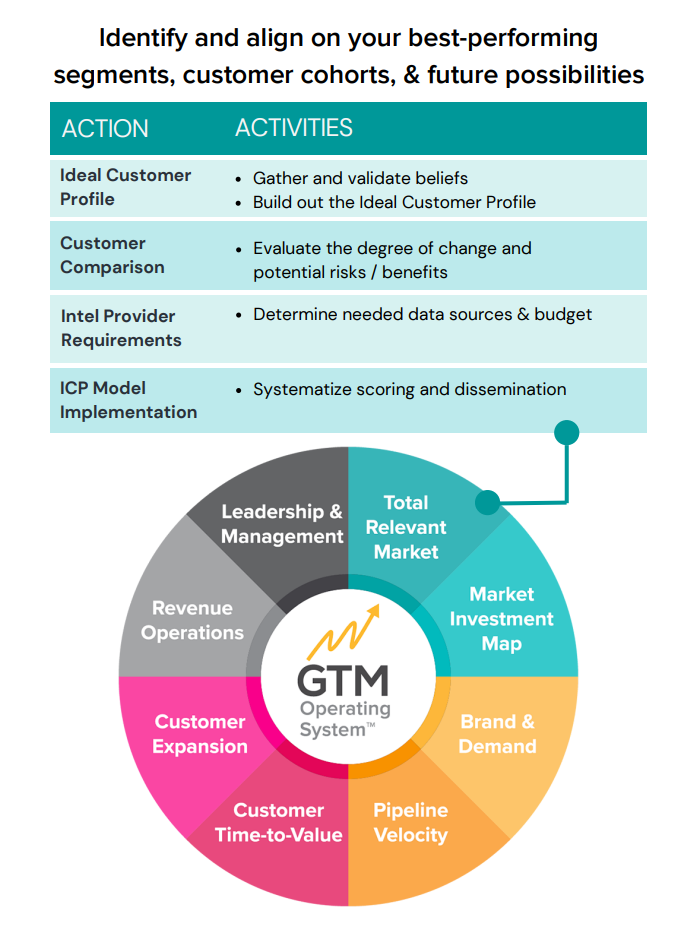
Pillar 1 answers one foundational question for the CEO and executive team: Where can we grow the most?
If your leadership team gives five different answers to “Who is our ideal customer?”, that disagreement is the root cause of pipeline waste, long deal cycles, and churn.
TRM replaces broad industry labels (e.g., “B2B SaaS in North America”) with strategic, behavior-based segment definitions.
How to Calculate Your Total Relevant Market in 4 Steps:
The 4 Categories of ICP Characteristics
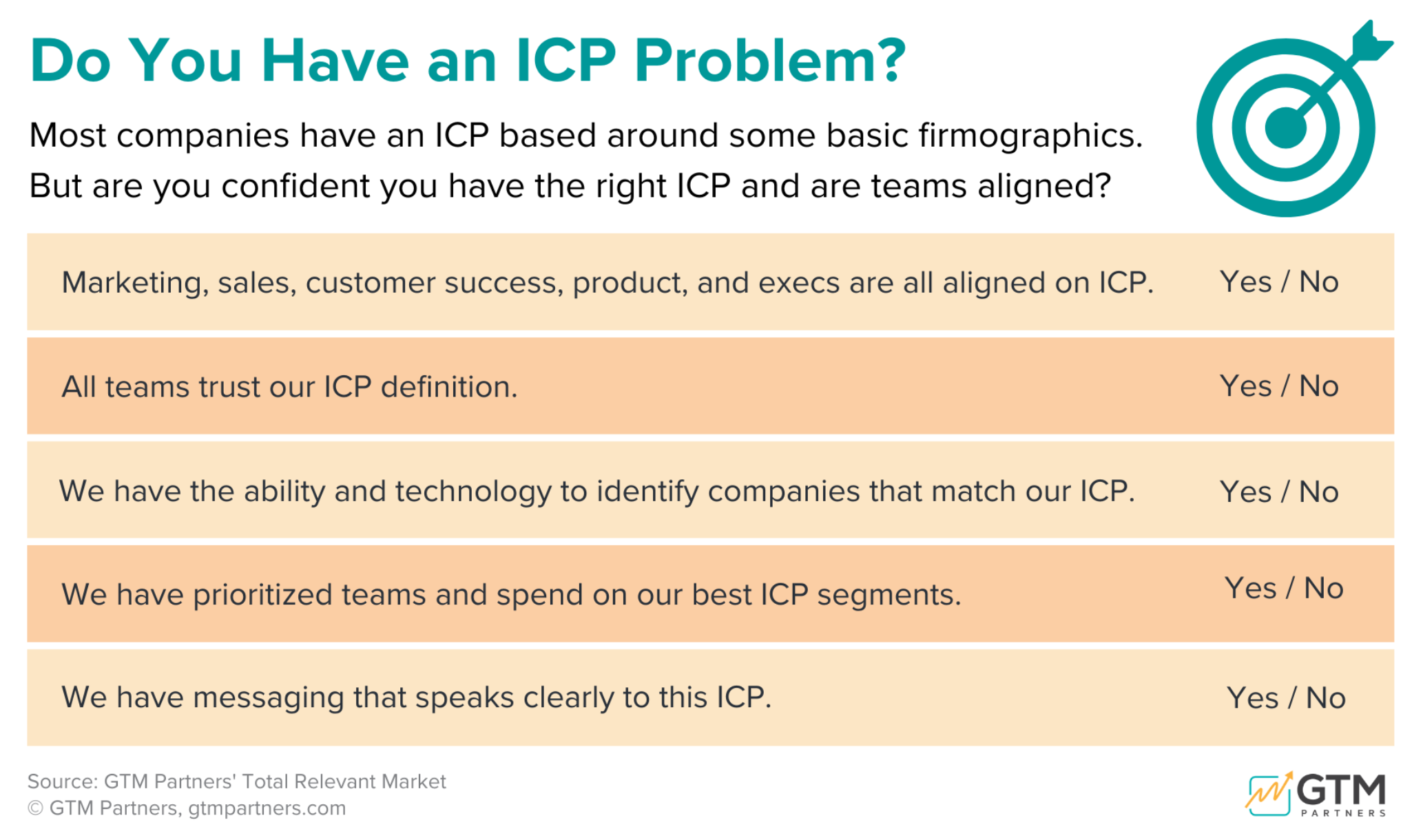
Most companies make the mistake of stopping at firmographics. A true GTM OS Ideal Customer Profile balances four distinct categories of data:
Firmographics (The Table Stakes)
Basic demographic parameters including industry, revenue bands, employee headcount, and geography. Firmographics establish the outer boundaries of who can buy, but provide zero indication of who will win.
Technographics (Stack & Sophistication)
The tools and systems an account uses. Technographics reveal complementary software (integrations you enhance), blocking tools (legacy systems that prevent adoption), and overall operational sophistication.
Qualifying Characteristics (Internal Reality)
The nuanced, internal facts that live in the heads of your top operators: If you sat in their executive all-hands, what would you observe? Examples include whether a dedicated internal role exists, centralized vs. decentralized procurement, or whether budget is already allocated.
Readiness to Buy (Timing & In-Market Signals)
Triggers indicating an account is ready to buy now: key leadership hires, funding rounds, regulatory deadlines, or intent surges. Rule: Use readiness as a dynamic prioritization filter, never as a permanent ICP score.
The -5 to +5 ICP Scoring Rubric
Rather than subjective “A/B/C” tiers, GTM Partners grades every account attribute on a disciplined -5 to +5 scale linked directly to customer lifetime value and Net Revenue Retention (NRR):
Multi-Segment Scoring & The SMB Trap
A single ICP score column is rarely sufficient if you sell to multiple buyer personas or segments. The same characteristic can score completely differently depending on the segment.
The SMB Trap: We frequently see scaling mid-market companies chase low-friction velocity deals in the SMB tier. The sales team celebrates high deal counts, but cohort analysis reveals 80% NRR. The excessive support time required by small accounts consumes gross margin and starves your high-value enterprise accounts of attention.
“TRM gave us the discipline to stop spreading named accounts across reps based on opinion. We set minimum ICP score thresholds so RevOps only allocates best-of-the-best accounts — so the whole team runs at the right targets.”
The 5 Layers of ICP Activation
Building an ICP model is only half the battle. Activating it across RevOps, Marketing, and Sales requires five synchronized layers:
Account Information Bias: Avoid treating an account with a low score as poor fit if its profile is simply incomplete. RevOps should flag incomplete profiles as TBD Accounts for SDR enrichment before disqualifying them.
How Companies Implement Total Relevant Market
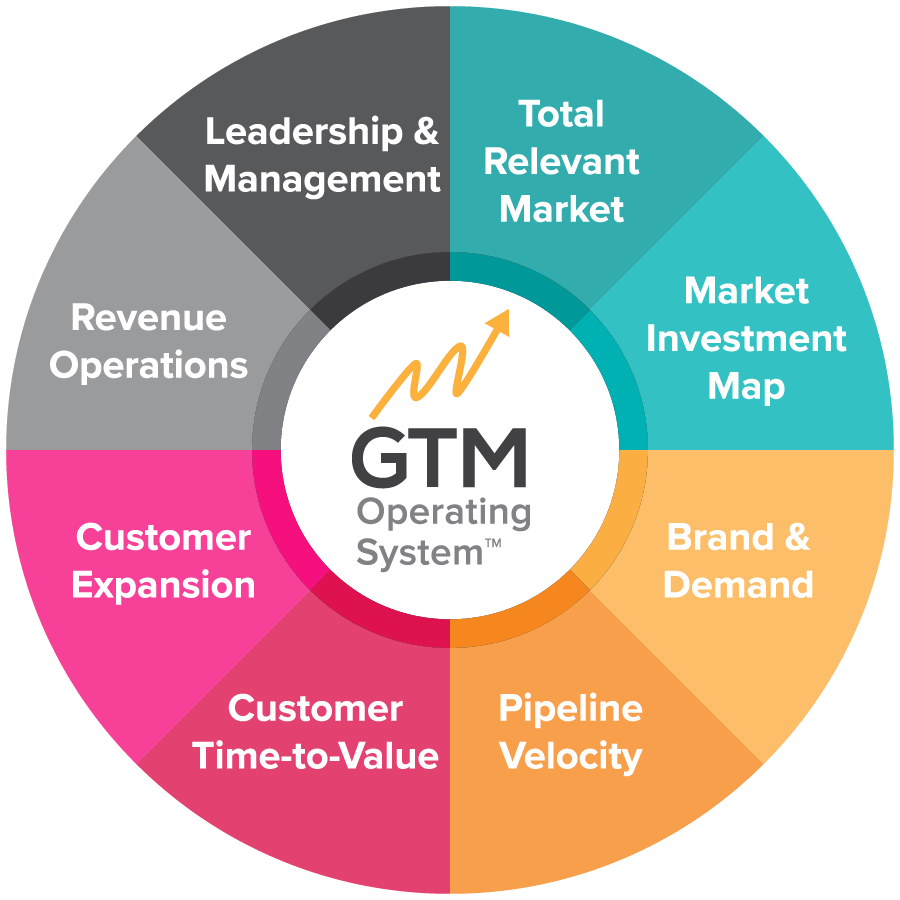
TRM is the foundational pillar of the GTM Operating System. When you sharpen market focus, every downstream pillar — product allocation (MIM), messaging (Brand & Demand), and sales throughput (Pipeline Velocity) — becomes dramatically more efficient.
Executive teams implement TRM with Certified GTM OS Partners through structured working sessions to build the customized scoring rubric, instrument the CRM, and establish account allocation thresholds.
Engage a Certified GTM OS Partner for Pillar 1 (TRM):
- • Cross-Functional ICP Workshop: Align CEO, Sales, Marketing, CS, and Product on exact customer fit attributes.
- • Scoring Model & Rubric Customization: Build the -5 to +5 mathematical model tailored to your unit economics.
- • RevOps & CRM Instrumentation: Automate account scoring, tiering, and territory distribution inside your tech stack.
What Executive Teams Say About Total Relevant Market
Perspectives from CEOs and revenue leaders who replaced subjective account assignment with objective ICP scoring.
"TRM gave us the discipline to stop spreading named accounts across reps based on opinion. We’re setting a minimum ICP score threshold so RevOps only allocates “best-of-the-best” accounts—so the whole team runs at the right targets."
"We didn’t want TRM to be a slide—so we embedded ICP score right next to MEDDIC in forecast calls. If a rep is chasing a low-fit deal, the question becomes immediate: “Why do you believe this will close?”—and that drives better focus."
"The biggest realization for me during the TRM work was that we had too many possible directions. We kept saying 'we could do this, we could do that,' and the opportunity space was basically endless. The process forced us to stop cataloging possibilities and instead identify the next best market opportunity where we can actually concentrate resources and win."
Ready to Focus Your GTM Engine on the Right Market?
Connect with a Certified GTM OS Partner to build your Total Relevant Market model, eliminate wasted pipeline, and focus your entire revenue team on high-NRR accounts.