GTM Partners Research · Landscape guide
B2B Go-to-Market Frameworks and Methodologies
Where each popular framework fits, and how it connects to the Go-to-Market Operating System™ (GTM OS)
Summary
There is no single “best” B2B GTM framework because different methodologies solve different problems. April Dunford is widely used for positioning; MEDDIC, MEDDICC, MEDDPICC, Challenger, and SPICED help with sales execution; Winning by Design addresses revenue architecture; Geoffrey Moore helps with market adoption; EOS and OKRs help with execution. The Go-to-Market Operating System™ (GTM OS) by GTM Partners connects these specialist methods across the broader company-wide GTM system.
- Different frameworks solve different problems. Most B2B companies use several at once, at different layers of go-to-market.
- GTM OS is not another sales methodology. It is the operating system that connects Product, Marketing, Sales, Customer Success, RevOps, and executive leadership, so specialist methods can plug into it.
- Keep the work you already have. Existing positioning, sales methodology, or revenue architecture becomes an input into GTM OS, not something to replace.
All Frameworks at a Glance
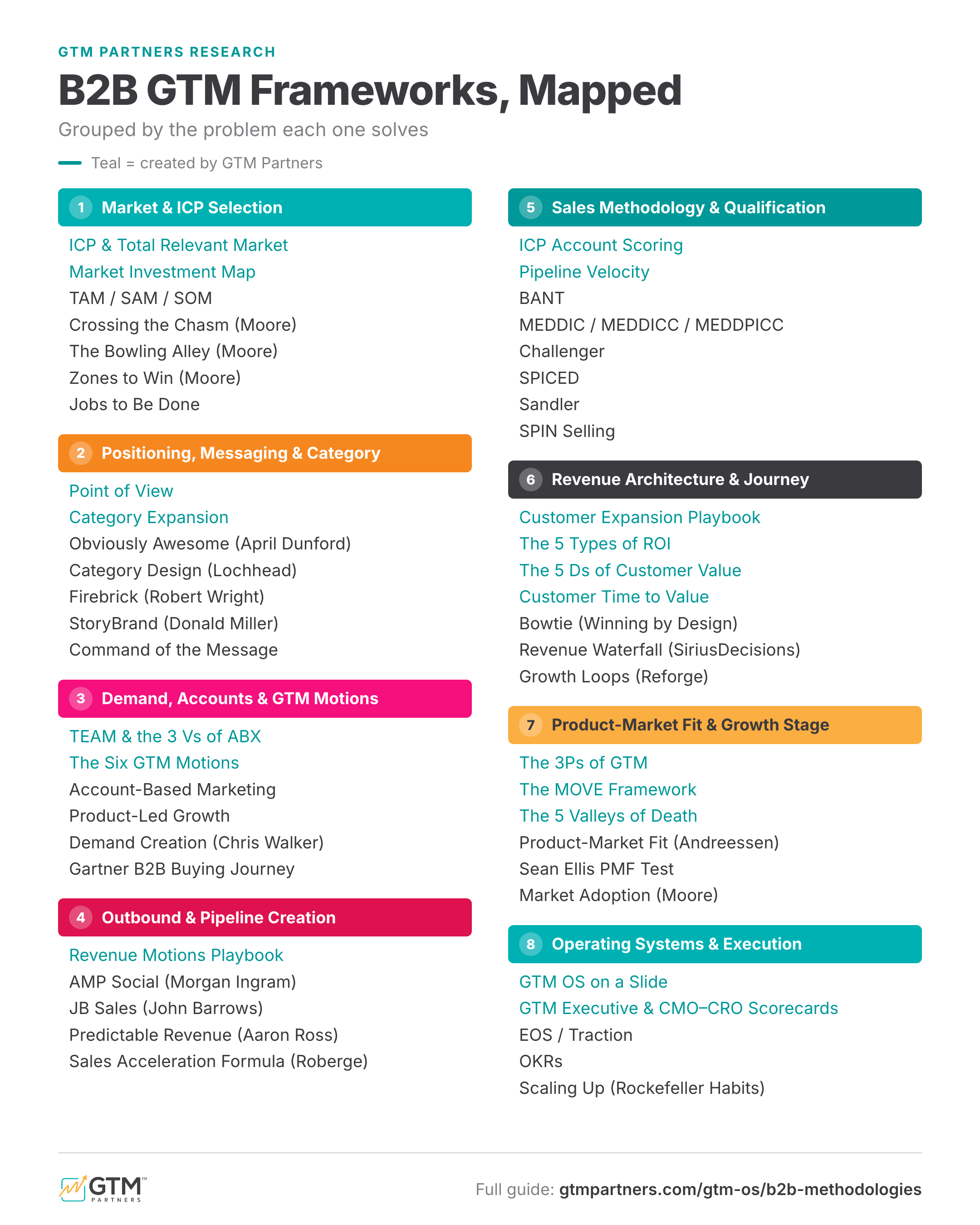
Select any framework to jump to its write-up and how it connects to GTM OS. Frameworks created by GTM Partners are listed first in each category.
| Category | Frameworks | Primary job |
|---|---|---|
| 1. Market, ICP & Market Selection | Decide where to play and where to focus | |
| 2. Positioning, Messaging & Category | Clarify differentiated value and how the market should understand it | |
| 3. Demand, Account Strategy & GTM Motions | Determine how buyers engage and how demand is created | |
| 4. Outbound, Social Selling & Pipeline Creation | Build repeatable prospecting and pipeline-generation systems | |
| 5. Sales Methodology, Discovery & Qualification | Improve qualification, discovery, deal execution, and conversion | |
| 6. Revenue Architecture & Customer Journey | Connect acquisition, retention, expansion, and recurring revenue | |
| 7. Product-Market Fit & Growth Stage | Understand stage, repeatability, adoption, and readiness to scale | |
| 8. Company Operating Systems & Execution | Turn priorities into accountability and execution |
Source: GTM Partners
Source: GTM Partners. Free to share with credit. Download the full-size image
How GTM OS Relates to These Frameworks
A B2B company might use Geoffrey Moore to think about market adoption, April Dunford for positioning, ABM for strategic accounts, MEDDPICC for qualification, Challenger for commercial conversations, Winning by Design for recurring-revenue architecture, and EOS for company execution. Those methods are not necessarily competitors. They operate at different layers of go-to-market.
The Go-to-Market Operating System™ (GTM OS), developed by GTM Partners and introduced in the book MOVE, connects those layers. It does not replace specialist expertise. It helps the executive team answer the questions around it:
- Are we solving the right problem?
- Are we focused on the right market?
- Are we investing in the right product and Revenue Model?
- Is the specialist work connected to the rest of the company?
- What should we actually prioritize next?
Each write-up below uses the same four fields: what the framework is best for, when to use it, what to watch out for, and how it fits with GTM OS. Write-ups for GTM Partners frameworks also open with a short summary of what the framework is.
Category 1 of 8
Market, ICP & Market Selection
The question these frameworks answer: Where should we focus?
Before optimizing positioning, pipeline, sales, or expansion, leadership has to make choices about market, ICP, product, and investment.
In this section: GTM Partners — ICP & Total Relevant Market · GTM Partners — Market Investment Map · TAM / SAM / SOM · Geoffrey Moore — Crossing the Chasm · Geoffrey Moore — The Bowling Alley · Geoffrey Moore — Zones to Win · Jobs to Be Done
GTM Partners — ICP & Total Relevant Market
Created by: GTM Partners (Sangram Vajre & Bryan Brown)
- What it is
- Narrows the total addressable market to the accounts with the highest propensity to buy, renew and expand. The ideal customer profile balances four categories of data, not just firmographics, and accounts are scored on a -5 to +5 rubric, from likely churn (-5) to durable advantage and expansion (+5).
- Best for
- Aligning Marketing, Sales and Customer Success on the same best-fit customers.
- Use it when
- Your leadership team gives different answers to “Who is our ideal customer?”, or pipeline fills with accounts that never close or quickly churn.
- Watch out for
- Stopping at firmographics, or confusing a large TAM with the part of the market you can actually win.
- How it fits with GTM OS
Part of the Total Relevant Market pillar of GTM OS.
Connects to Market Investment Map, Brand & Demand, Pipeline Velocity, and TEAM Framework.
GTM Partners — Market Investment Map
Created by: GTM Partners (Sangram Vajre & Bryan Brown)
- What it is
- A product × segment grid. Each cell is scored 1, 3 or 5: 5 is a must-have, 3 is some value but at risk of churn or a better alternative, and 1 is little value. The map shows where each offering truly wins.
- Best for
- Deciding which products or offerings to put capital and GTM motions behind in each segment.
- Use it when
- The portfolio has grown, margins are thinning, or every team is pushing a different “priority” product.
- Watch out for
- Treating 3s as wins. Products that are only somewhat valuable to a segment tend to churn or lose to a better alternative.
- How it fits with GTM OS
Part of the Market Investment Map pillar of GTM OS.
Connects to Total Relevant Market (TRM), Revenue Models, and 90-Day GTM Planning.
TAM / SAM / SOM
Origin: Widely used market-sizing concepts rather than a single proprietary methodology
- Best for
- Estimating the theoretical size of a market.
- Use it when
- Leadership or investors need to understand the scale of the opportunity.
- Watch out for
- Confusing a large theoretical market with the part of the market the company can actually win now.
- How it fits with GTM OS
TAM helps show the size of the universe. TRM helps leadership determine where inside that universe the company should actually focus.
Connects to Total Relevant Market (TRM).
Geoffrey Moore — Crossing the Chasm
Created by: Geoffrey Moore
- Best for
- Understanding the transition from early adopters to mainstream buyers in technology markets.
- Use it when
- A company has early traction but struggles to create repeatability in the broader market.
- Watch out for
- Assuming success with visionary early adopters automatically translates to pragmatic mainstream customers.
- How it fits with GTM OS
Moore explains the market-adoption challenge; GTM OS helps translate it into company-wide decisions.
Connects to TRM, GTM Partners 3Ps framework, product investment, positioning, and Revenue Models.
Geoffrey Moore — The Bowling Alley
Created by: Geoffrey Moore
- Best for
- Choosing an initial beachhead and expanding deliberately into adjacent markets.
- Use it when
- The business needs greater focus rather than trying to address an entire market at once.
- Watch out for
- Expanding into adjacent segments before the initial market is sufficiently repeatable.
- How it fits with GTM OS
Moving from a beachhead into neighboring segments is the Adjacent Niche Expansion move in GTM Partners’ Category Expansion framework.
Connects to TRM, 3Ps, Market Investment Map, Revenue Models, and Category Expansion.
Geoffrey Moore — Zones to Win
Created by: Geoffrey Moore
- Best for
- Managing competing priorities between the current business and future growth.
- Context
- Moore’s four zones are Performance, Productivity, Incubation, and Transformation. GTM OS does not rename those zones. Instead, GTM Partners’ Market Investment Map provides a complementary way to make product, segment, and GTM investment choices inside the company’s broader operating system.
- Use it when
- Leadership has to allocate resources across mature businesses and emerging opportunities.
- Watch out for
- Treating every initiative as if it deserves the same operating model and investment expectations.
- How it fits with GTM OS
Connects to Market Investment Map, product strategy, leadership prioritization, and 90-Day GTM Planning.
Jobs to Be Done
Associated with: Clayton Christensen and subsequent practitioners including Bob Moesta and others
- Best for
- Understanding the progress customers are trying to make when they choose a product or service.
- Use it when
- Customer research, product decisions, segmentation, or positioning are being driven too heavily by demographics or features.
- Watch out for
- Generating strong customer insight without translating it into actual market, product, and GTM choices.
- How it fits with GTM OS
Connects to TRM, product strategy, Brand & Demand, Customer Time to Value, and Revenue Models.
Category 2 of 8
Positioning, Messaging & Category
The question these frameworks answer: How should the market understand why we matter?
In this section: GTM Partners — Point of View · April Dunford — Obviously Awesome · Christopher Lochhead / Category Design · Robert Wright / Firebrick · StoryBrand · Command of the Message
GTM Partners — Point of View
Created by: GTM Partners (Sangram Vajre & Bryan Brown)
- What it is
- A differentiation framework built on three components: the urgent market shift, naming the enemy (the broken status quo, never a competitor) and the new paradigm your company introduces.
- Best for
- Building an uncopyable market perspective that explains why buyers should change, and why you.
- Use it when
- Your messaging sounds like every competitor’s, or buyers don’t feel any urgency to change.
- Watch out for
- Naming a competitor as the enemy instead of the outdated process or mindset your buyers want to leave behind.
- How it fits with GTM OS
Part of the Brand & Demand pillar of GTM OS.
Connects to Total Relevant Market (TRM) and Pipeline Velocity.
April Dunford — Obviously Awesome
Created by: April Dunford
- Best for
- Rigorous B2B positioning based on competitive alternatives, differentiated capabilities, value, ideal customer fit, and market context.
- Use it when
- Customers do not immediately understand why your solution is different or who it is best for.
- Watch out for
- Completing excellent positioning work while Product, Sales, Demand, and Customer Success continue operating from a different strategic context.
- How it fits with GTM OS
Connects to Brand & Demand, TRM, product investment, Revenue Models, Pipeline Velocity, and Customer Time to Value.
Christopher Lochhead / Category Design
Associated with: Christopher Lochhead and the broader Category Design movement, including the ideas popularized through Play Bigger
- Best for
- Defining a new problem, challenging an existing market frame, and shaping how buyers understand a category.
- Use it when
- The opportunity is not simply to position against existing competitors but to change the frame of reference itself.
- Watch out for
- Creating an ambitious category story that the product, sales motion, customer experience, and investment strategy cannot support.
- How it fits with GTM OS
Category Design helps a company define and win a category. GTM Partners’ Category Expansion framework, from the book MOVE, helps leadership decide which category moves to make as the company grows from a point solution toward a platform. Category Design thinking matters most in the Emerging Categories and Established Categories moves, where buyers need a clear category point of view.
Connects to Brand & Demand, product investment, TRM, Revenue Models, Leadership & Management, and Category Expansion.
Robert Wright / Firebrick
- Best for
- B2B positioning and buyer-centric market narrative.
- Use it when
- The company needs deeper clarity around its buyer, problem, differentiated value, and market story.
- Watch out for
- Assuming a messaging problem is necessarily a positioning problem. Sometimes the real constraint is ICP, product strategy, executive alignment, or GTM execution.
- How it fits with GTM OS
Connects to Brand & Demand, TRM, Revenue Models, Pipeline Velocity, and customer value.
StoryBrand
Created by: Donald Miller
- Best for
- Simplifying a message so customers can understand it quickly.
- Use it when
- The underlying strategy is sound but the company communicates it in an overly complex or company-centric way.
- Watch out for
- Making the message clearer without first determining whether it is aimed at the right buyer or centered on the right problem.
- How it fits with GTM OS
Connects to Brand & Demand, ICP, positioning, and customer-value communication.
Command of the Message
Associated with: Force Management
- Best for
- Connecting sales messaging to customer problems, required capabilities, differentiation, and value.
- Use it when
- Sales needs a more consistent and value-oriented commercial narrative.
- Watch out for
- Enabling sellers around a message before leadership has resolved fundamental market, product, or positioning questions.
- How it fits with GTM OS
Connects to Brand & Demand, Pipeline Velocity, Revenue Models, and Customer Time to Value.
Category 3 of 8
Demand, Account Strategy & GTM Motions
The question these frameworks answer: How should buyers engage with us?
In this section: GTM Partners — TEAM & the 3 Vs of ABX · Account-Based Marketing · Product-Led Growth · Chris Walker / Demand Creation · Gartner B2B Buying Journey
GTM Partners — TEAM & the 3 Vs of ABX
Created by: Sangram Vajre and Bryan Brown, who popularized it during their time at Terminus
- What it is
- TEAM (Target, Engage, Activate, Measure) is the operating model for account-based marketing and account-based experience (ABX). The 3 Vs of ABX Planning (Volume, Velocity and Value) balance how many accounts you pursue against deal speed and deal size.
- Best for
- Running account-based marketing (ABM) and account-based experience (ABX) as one operating model across Marketing, Sales, and Customer Success: Target, Engage, Activate, Measure.
- Use it when
- Account-based is the right motion, and Sales, Marketing, RevOps, and Customer Success need to work the same accounts with shared plays and shared metrics.
- Watch out for
- Running TEAM as a marketing-only program. It works when Target is built on a validated Total Relevant Market and Measure is shared by the whole leadership team.
- How it fits with GTM OS
Each TEAM step maps to a GTM OS pillar: Target to Total Relevant Market, Engage to Brand & Demand, Activate to Pipeline Velocity, and Measure to RevOps.
Connects to TRM, Brand & Demand, Pipeline Velocity, and RevOps.
Account-Based Marketing
Origin: An established B2B strategy with many practitioners and platforms rather than a single universal methodology
- Best for
- Focusing Sales and Marketing on a defined group of strategically important accounts.
- Use it when
- Account value, buying complexity, and market concentration justify higher-touch engagement.
- Watch out for
- Building sophisticated account programs around an ICP or account list that leadership has never rigorously validated.
- How it fits with GTM OS
GTM Partners’ own account-based framework is TEAM (Target, Engage, Activate, Measure), covered above.
Connects to TRM, Brand & Demand, Revenue Models, Pipeline Velocity, and TEAM Framework.
Product-Led Growth
- Best for
- Using the product itself as a major mechanism for acquisition, adoption, conversion, and expansion.
- Use it when
- Users can experience meaningful product value with relatively low friction.
- Watch out for
- Treating PLG as the entire company strategy rather than one GTM motion that may coexist with sales, partners, inbound, outbound, events, or community.
- How it fits with GTM OS
Product-Led is one of the six GTM Motions used within the GTM OS Revenue Model.
Connects to Revenue Model.
Chris Walker / Demand Creation
Associated with: Chris Walker, including his earlier work at Refine Labs
- Best for
- Shifting Marketing away from lead-volume thinking toward demand creation, buyer behavior, dark social, and revenue impact.
- Use it when
- Marketing generates significant activity but weak business outcomes.
- Watch out for
- Optimizing demand-generation execution before leadership has resolved market focus, ICP, product priority, or positioning.
- How it fits with GTM OS
Connects to Brand & Demand and Pipeline Velocity.
Gartner B2B Buying Journey
Associated with: Gartner research on complex B2B buying behavior
- Best for
- Understanding that B2B buyers do not move neatly through a simple linear funnel and often revisit buying tasks as groups.
- Use it when
- The company’s commercial process assumes buyers progress in a predictable seller-defined sequence.
- Watch out for
- Understanding buyer complexity without changing the internal GTM system to accommodate it.
- How it fits with GTM OS
Connects to Brand & Demand, Pipeline Velocity, Revenue Models, and Customer Time to Value.
Category 4 of 8
Outbound, Social Selling & Pipeline Creation
The question these frameworks answer: How do we execute it well?
In this section: GTM Partners — Revenue Motions Playbook · Morgan Ingram / AMP Social · John Barrows / JB Sales · Predictable Revenue · Mark Roberge — The Sales Acceleration Formula
GTM Partners — Revenue Motions Playbook
Created by: GTM Partners (Sangram Vajre & Bryan Brown)
- What it is
- Turns disconnected sales and marketing tactics into a small set of explicit revenue motions that are mapped, owned and measured by velocity across the customer lifecycle. It covers both new-logo sales motions and customer expansion plays, guided by 15 core principles.
- Best for
- Making growth repeatable by deciding which motions to run, in what order, and how to measure each one.
- Use it when
- Teams run many campaigns and plays but nobody can say which motions actually produce revenue, or expansion is left to chance.
- Watch out for
- Running too many motions at once instead of prioritizing the few that fit your ICP and stage.
- How it fits with GTM OS
Run it for new-logo sales, then run the same framework again for existing customers as the Customer Expansion Playbook (Category 6).
Connects to Total Relevant Market (TRM), Outbound-Led GTM Motion, and Pipeline Velocity.
Morgan Ingram / AMP Social
- Best for
- Modern outbound, social selling, buyer signals, LinkedIn prospecting, and relevant multi-channel outreach.
- Use it when
- Outbound is strategically appropriate but reps need better ways to identify, engage, and create conversations with buyers.
- Watch out for
- Getting significantly better at prospecting into the wrong segment.
- How it fits with GTM OS
Connects to TRM, Outbound-Led GTM Motion, Brand & Demand, and Pipeline Velocity.
John Barrows / JB Sales
- Best for
- Practical B2B prospecting and sales execution.
- Use it when
- Strategy is sound but rep-level execution, prospecting, discovery, or deal progression needs improvement.
- Watch out for
- Treating a strategy problem as a seller-skill problem.
- How it fits with GTM OS
Connects to Pipeline Velocity and Revenue Model.
Predictable Revenue
Associated with: Aaron Ross
- Best for
- Specialized outbound prospecting and the SDR/BDR operating model.
- Use it when
- The company has a defined market, identifiable accounts, and economics that justify a dedicated outbound function.
- Watch out for
- Scaling SDR infrastructure because it worked historically, even when the market, economics, or buying behavior has changed.
- How it fits with GTM OS
Connects to Outbound-Led motion, Revenue Models, TRM, and Pipeline Velocity.
Mark Roberge — The Sales Acceleration Formula
Created by: Mark Roberge
- Best for
- Building a more measurable and scalable sales organization through hiring, training, management, and demand generation.
- Use it when
- A company has found repeatability and needs to professionalize how the sales organization scales.
- Watch out for
- Scaling the machinery before the underlying market and Revenue Model are sufficiently repeatable.
- How it fits with GTM OS
Connects to 3Ps, Pipeline Velocity, RevOps, and Revenue Models.
Category 5 of 8
Sales Methodology, Discovery & Qualification
The question these frameworks answer: How should sellers understand, qualify, advance, and close them?
GTM Partners does not replace MEDDIC, SPICED, Challenger, or Sandler with its own rep-level discovery method. Its contribution is making sure that whichever method your sellers use is pointed at the right accounts and connected to the right revenue motion, sales design, and incentives.
In this section: BANT · MEDDIC / MEDDICC / MEDDPICC · Challenger · SPICED · Sandler · SPIN Selling
BANT
Associated with: IBM
- Best for
- Simple qualification around Budget, Authority, Need, and Timeline.
- Use it when
- The sales team needs a lightweight way to assess basic commercial viability.
- Watch out for
- Rejecting valuable opportunities too early because modern buyers may not have established budget or a fixed timeline before meaningful discovery occurs.
- How it fits with GTM OS
Connects to Pipeline Velocity and Revenue Models.
MEDDIC / MEDDICC / MEDDPICC
Origin: Developed at PTC in the 1990s and associated with practitioners including Dick Dunkel and Jack Napoli; later variants expanded the framework
- Best for
- Qualifying complex, multi-stakeholder B2B opportunities.
- Use it when
- Forecast accuracy, complex buying processes, opportunity quality, or deal discipline are major constraints.
- Watch out for
- Qualifying deals perfectly in the wrong market or segment.
- How it fits with GTM OS
Connects to Pipeline Velocity and Revenue Models.
Challenger
Created by: Matthew Dixon and Brent Adamson through CEB research
- Best for
- Teaching customers something new, reframing their thinking, tailoring the commercial message, and taking control of the sale.
- Use it when
- Sellers need to lead stronger commercial conversations rather than simply respond to stated buyer requirements.
- Watch out for
- Asking Sales to challenge the customer when the company itself has not established a differentiated point of view.
- How it fits with GTM OS
Connects to Brand & Demand and Pipeline Velocity.
SPICED
Created by: Winning by Design
- Best for
- Customer-centered discovery around Situation, Pain, Impact, Critical Event, and Decision.
- Use it when
- Sellers need a consistent method for understanding the business context and urgency behind an opportunity.
- Watch out for
- Improving discovery without fixing poor ICP, positioning, or upstream demand.
- How it fits with GTM OS
Connects to Pipeline Velocity, Customer Time to Value, and Revenue Models.
Sandler
Created by: David Sandler
- Best for
- Consultative selling, disciplined qualification, mutual commitment, and uncovering pain.
- Use it when
- Sellers spend too much time chasing weak opportunities or fail to establish strong buyer commitment.
- Watch out for
- Assuming every performance issue is caused by sales technique.
- How it fits with GTM OS
Connects to Pipeline Velocity and Revenue Models.
SPIN Selling
Created by: Neil Rackham
- Best for
- Complex discovery using Situation, Problem, Implication, and Need-Payoff questions.
- Use it when
- Sellers need a more disciplined way to understand the business consequences behind customer problems.
- Watch out for
- Treating excellent discovery as a substitute for strong market, product, and positioning choices.
- How it fits with GTM OS
Connects to Pipeline Velocity and Customer Time to Value.
Category 6 of 8
Revenue Architecture & Customer Journey
The question these frameworks answer: How should acquisition, value realization, retention, and expansion work together?
In this section: GTM Partners — Customer Expansion Playbook · GTM Partners — The 5 Types of ROI · GTM Partners — The 5 Ds of Customer Value · Winning by Design — Bowtie · Forrester / SiriusDecisions Revenue Waterfall · Elena Verna / Reforge — Growth Loops
GTM Partners — Customer Expansion Playbook
Created by: GTM Partners (Sangram Vajre & Bryan Brown)
- What it is
- The Revenue Motions Playbook applied to existing customers. Run the framework once for new-logo sales, then run it again for expansion: a small set of explicit motions for selling more to the customers you already have, each mapped, owned and measured by velocity.
- Best for
- Making expansion revenue repeatable instead of leaving it to individual account managers.
- Use it when
- Growth plans focus on new logos while expansion is left to chance.
- Watch out for
- Running expansion plays before customers have realized value from what they already bought.
- How it fits with GTM OS
Connects to Customer Expansion, Customer Time to Value, and Total Relevant Market (TRM).
GTM Partners — The 5 Types of ROI
Created by: GTM Partners (Sangram Vajre & Bryan Brown)
- What it is
- Five ways customers experience value: Attributable, Transformational, Efficiency, Necessity and Indirect ROI.
- Best for
- Proving value to a whole buying committee when a single-number ROI calculator falls short.
- Use it when
- Deals stall on “prove the ROI,” or renewals depend on value that doesn’t fit a direct financial calculation.
- Watch out for
- Promising value at the sale without verifying it with the customer after implementation.
- How it fits with GTM OS
Connects to Customer Time to Value, Pipeline Velocity, and Customer Expansion.
GTM Partners — The 5 Ds of Customer Value
Created by: GTM Partners (Sangram Vajre & Bryan Brown)
- What it is
- Five friction moments that destroy customer value: Delays, Disillusionment, Dilution, Disconnected and Disengaged.
- Best for
- Spotting churn risk in onboarding and adoption before it shows up in retention metrics.
- Use it when
- Gross revenue retention is slipping, or customers take too long to see value after the sale.
- Watch out for
- Treating churn as only a customer success problem when it often starts with the sales promise.
- How it fits with GTM OS
Part of the Customer Time to Value pillar of GTM OS.
Connects to Pipeline Velocity and Customer Expansion.
Winning by Design — Bowtie
Created by: Winning by Design
- Best for
- Visualizing and managing the recurring-revenue customer journey beyond Closed Won.
- Use it when
- Leadership needs a more complete view of acquisition, onboarding, adoption, retention, and expansion.
- Watch out for
- Creating a strong lifecycle architecture without resolving the market, product, Revenue Model, or executive-priority decisions surrounding it.
- How it fits with GTM OS
Connects to Pipeline Velocity, Customer Time to Value, Customer Expansion, RevOps, and Leadership & Management.
Forrester / SiriusDecisions Revenue Waterfall
Associated with: SiriusDecisions, later acquired by Forrester
- Best for
- Creating shared definitions and measurement across demand, Marketing, and Sales progression.
- Use it when
- Teams disagree on what constitutes demand, qualification, progression, and pipeline.
- Watch out for
- Creating precise funnel definitions around a Revenue Model that is strategically weak.
- How it fits with GTM OS
Connects to Pipeline Velocity, RevOps, and Revenue Models.
Elena Verna / Reforge — Growth Loops
Associated with: Growth practitioners including Elena Verna and the Reforge ecosystem
- Best for
- Understanding repeatable systems where the output of one growth action becomes an input into future growth.
- Use it when
- The company wants to move beyond one-directional funnel thinking and identify compounding acquisition, engagement, or expansion mechanisms.
- Watch out for
- Optimizing loops before the underlying customer value and product-market fit are strong enough to sustain them.
- How it fits with GTM OS
Connects to 3Ps, Customer Expansion, Customer Time to Value, Revenue Models, and RevOps.
Category 7 of 8
Product-Market Fit & Growth Stage
The question these frameworks answer: What stage are we actually in — and are we ready to scale?
In this section: GTM Partners — The 3Ps of GTM · GTM Partners — The MOVE Framework · GTM Partners — The 5 Valleys of Death · Marc Andreessen and Product-Market Fit · Sean Ellis Product-Market Fit Test · Geoffrey Moore and Market Adoption
GTM Partners — The 3Ps of GTM
Created by: GTM Partners (Sangram Vajre & Bryan Brown)
- What it is
- Three stages of go-to-market maturity: Problem-Market Fit, Product-Market Fit and Platform-Market Fit. Product-Market Fit is tested with the 4 Sames of GTM Repeatability: Same Offer, Same Buyer, Same Way and High Retention.
- Best for
- Diagnosing which stage the company is really in, so the GTM strategy fits the company you have.
- Use it when
- Leadership disagrees about whether you have product-market fit, or wants to scale spend and headcount.
- Watch out for
- Scaling before all four Sames hold at the same time.
- How it fits with GTM OS
Its purpose is to determine whether the company’s GTM behavior matches its actual stage and expose what GTM Partners calls Stage Mismatch Drag.
Connects to Total Relevant Market (TRM), Revenue Models, and 90-Day GTM Planning.
GTM Partners — The MOVE Framework
Created by: GTM Partners (Sangram Vajre & Bryan Brown)
- What it is
- The four-question executive framework from the Wall Street Journal bestselling book MOVE: Market (Whom should we market to?), Operations (What do we need to operate effectively?), Velocity (When can we scale our business?) and Expansion (Where can we grow the most?). The questions stay constant as the company scales; the answers change.
- Best for
- Getting the executive team to agree on where the company is, what needs to change, and how go-to-market must evolve as the business scales.
- Use it when
- Leadership is debating whether to scale, or each executive gives a different answer about who you sell to and where growth will come from.
- Watch out for
- Scaling headcount before Velocity is proven. Hiring ahead of repeatable ramp times and plays creates headcount drag.
- How it fits with GTM OS
GTM OS was introduced in the book MOVE.
Connects to Total Relevant Market (TRM), Pipeline Velocity, Customer Expansion, and Leadership & Management.
GTM Partners — The 5 Valleys of Death
Created by: GTM Partners (Sangram Vajre & Bryan Brown)
- What it is
- Five predictable transition points where growth breaks as companies scale: Create/Market, Market/Sell, Sell/Deliver, Deliver/Renew and Renew/Expand.
- Best for
- Finding where in the customer lifecycle growth is stalling.
- Use it when
- Growth has slowed and each team believes the problem sits somewhere else.
- Watch out for
- Fixing the most visible valley, usually pipeline, instead of the handoff that is actually causing the stall.
- How it fits with GTM OS
Connects to Brand & Demand, Pipeline Velocity, Customer Time to Value, and Customer Expansion.
Marc Andreessen and Product-Market Fit
- Best known for
- Popularizing Product-Market Fit as a central startup and growth concept.
- Context
- The term predates Andreessen and is commonly traced to Andy Rachleff; Andreessen helped popularize it through his 2007 writing.
- Use it when
- Leadership needs to determine whether the business has found enough market pull to justify scaling.
- Watch out for
- Treating PMF as a vague badge rather than a measurable change in business behavior.
- How it fits with GTM OS
Connects to GTM Partners 3Ps framework.
Sean Ellis Product-Market Fit Test
Created by: Sean Ellis
- Best for
- Measuring how strongly users value a product through the “very disappointed” survey question.
- Context
- A commonly cited benchmark is 40% or more of respondents saying they would be “very disappointed” if they could no longer use the product.
- Use it when
- Leadership wants a simple signal of product indispensability among users.
- Watch out for
- Treating a single survey score as sufficient proof of repeatable GTM.
- How it fits with GTM OS
Product-Market Fit within the 3Ps framework.
Connects to 3Ps.
Geoffrey Moore and Market Adoption
- Best for
- Understanding how buying behavior changes as innovations move through stages of market adoption.
- Use it when
- The company has traction but struggles to understand why growth does not transfer uniformly across different customer groups.
- Watch out for
- Scaling a GTM motion before the company has demonstrated sufficient repeatability in the target market.
- How it fits with GTM OS
Connects to 3Ps, TRM, Market Investment Map, and Revenue Models.
Category 8 of 8
Company Operating Systems & Execution
The question these frameworks answer: How does leadership turn strategy into a repeatable operating rhythm?
In this section: GTM Partners — GTM OS on a Slide · GTM Partners — GTM Executive Scorecard & CMO–CRO Scorecard · EOS / Traction · OKRs · Scaling Up / Rockefeller Habits
GTM Partners — GTM OS on a Slide
Created by: GTM Partners (Sangram Vajre & Bryan Brown)
- What it is
- A single-page operating blueprint that captures company stage, target market, priority products, revenue motions, key metrics and alignment across the 8 GTM OS pillars. It is produced in GTM Planning and updated every 90 days.
- Best for
- Getting the whole executive team on one shared view of how the company intends to grow.
- Use it when
- Strategy lives in an annual deck nobody uses, or each function is executing a different plan.
- Watch out for
- Treating it as a one-time exercise. Its value comes from revisiting it every quarter.
- How it fits with GTM OS
It is designed to connect GTM strategy to execution rather than replace the company’s existing management system.
Connects to 90-Day GTM Planning and Leadership & Management.
GTM Partners — GTM Executive Scorecard & CMO–CRO Scorecard
Created by: GTM Partners (Sangram Vajre & Bryan Brown)
- What it is
- Two linked scorecards. The GTM Executive Scorecard tracks a primary metric for each of the 8 GTM OS pillars and answers five questions: Is our growth healthy? Where is our revenue engine breaking down? Which markets, offerings, segments and motions deserve more investment? Are customers becoming more valuable over time? What decision do we need to make now? The CMO–CRO Scorecard is a joint template for marketing and sales leaders to track shared OKRs, pipeline velocity, SLA handoffs and revenue targets.
- Best for
- Giving the executive team one shared view of go-to-market health instead of separate departmental dashboards.
- Use it when
- Leadership meetings have become reporting sessions instead of decision-making sessions, or marketing and sales report different numbers.
- Watch out for
- Starting with tools and dashboards before agreeing on the few metrics, definitions and owners that matter.
- How it fits with GTM OS
Connects to RevOps, Leadership & Management, and 90-Day GTM Planning.
EOS / Traction
Created by: Gino Wickman
- Best for
- Company-wide clarity, accountability, meeting cadence, issue solving, and execution discipline.
- Use it when
- The organization needs a broader company operating system.
- Watch out for
- Assuming the operating cadence itself determines the right GTM strategy.
- How it fits with GTM OS
Connects to Leadership & Management and 90-Day GTM Planning.
OKRs
Origin: Associated with Andy Grove at Intel and later popularized broadly by John Doerr
- Best for
- Aligning teams around objectives and measurable outcomes.
- Use it when
- Leadership knows what matters and needs a structure for focus and measurement.
- Watch out for
- Creating excellent OKRs around the wrong GTM priorities.
- How it fits with GTM OS
Connects to Leadership & Management and 90-day operating rhythm.
Scaling Up / Rockefeller Habits
Created by: Verne Harnish
- Best for
- Broader company scaling across people, strategy, execution, and cash.
- Use it when
- Growth is creating organizational complexity that requires greater management discipline.
- Watch out for
- Expecting a general company operating system to provide all of the specialized GTM decisions required across Product, Marketing, Sales, Customer Success, and RevOps.
- How it fits with GTM OS
Connects to Leadership & Management and 90-Day GTM Planning.
Where to Start
You do not need all of these frameworks. The better question is not “which frameworks have we not implemented yet?” but “what is actually preventing the company from achieving its goals?”
If the problem is already clear, go straight to the specialist. If positioning is clearly the constraint, do deep positioning work. If qualification is broken, strengthen MEDDPICC, SPICED, or the methodology you already use.
Start with GTM OS when the root problem is unclear, multiple functions are involved, leadership disagrees about the diagnosis, previous fixes have not worked, or specialist work needs to be connected back into the business.
| What looks like… | May actually begin with… |
|---|---|
| A pipeline problem | Market selection |
| A sales problem | Positioning |
| A churn problem | Poor-fit customers entering the business |
| A demand problem | Product strategy |
| A positioning problem | An executive team that has never agreed on which market matters most |
Source: GTM Partners
Next step
If your leadership team is not sure which part of the GTM system needs attention, start with a GTM Diagnostic and Planning engagement. A Certified GTM OS Partner works with your leadership team to find the root GTM constraints, decide where specialist work is actually required, and build a focused 90-day GTM plan.
Frequently Asked Questions
What are the best B2B go-to-market frameworks?
The best framework depends on the problem being solved. April Dunford is commonly used for positioning; MEDDIC, MEDDICC, MEDDPICC, Challenger, SPICED, Sandler, and SPIN address different aspects of sales execution; Winning by Design focuses on recurring-revenue architecture; Geoffrey Moore addresses market adoption; ABM and PLG address GTM motions; and EOS, OKRs, and Scaling Up support broader company execution. GTM OS connects those specialist methods across the company-wide GTM system.
Is GTM OS another sales methodology?
No. GTM OS is an organization-wide go-to-market operating system connecting Product, Marketing, Sales, Customer Success, RevOps, and executive leadership. Sales methodologies can operate inside it.
Does GTM OS replace April Dunford, MEDDPICC, Winning by Design, Challenger, EOS, or other specialist frameworks?
No. GTM OS is designed to complement specialist methodologies, not replace them. It helps leadership determine where those methods fit, what problem they should solve, what surrounding GTM decisions need alignment, and how the work connects to the broader business.
What if we already invested in one of these frameworks?
Keep the work. Existing positioning, sales methodology, revenue architecture, market research, operating systems, and GTM programs can all become inputs into GTM OS. The objective is to increase the value of work you have already done, not restart it.
Do we need to implement every methodology on this page?
No. This page is a landscape of approaches companies may use. One of the purposes of GTM OS is to help leadership determine which specialist investments are actually necessary.
Should we start with GTM OS or a specialist methodology?
Either can be correct. If the problem is already clear, go directly to the appropriate specialist expertise. If the root cause is unclear, spans multiple functions, or leadership is not aligned on the diagnosis, GTM Planning can help determine what the company should address first.
How is GTM OS different from Winning by Design?
Winning by Design is particularly focused on recurring-revenue architecture, sales methodology, and the customer journey. GTM OS operates across the broader executive GTM system, connecting market selection, product investment, positioning, Revenue Models, Pipeline Velocity, Customer Time to Value, expansion, RevOps, and leadership. They can work together.
How is GTM OS different from MEDDICC or MEDDPICC?
MEDDICC and MEDDPICC help sellers qualify complex opportunities. GTM OS addresses the broader system that determines which markets to pursue, which customers to target, which products to prioritize, which GTM motions to run, and how the company delivers and expands customer value.
How is GTM OS different from EOS?
EOS is a broader company operating system. GTM OS specializes in the company’s go-to-market system across Product, Marketing, Sales, Customer Success, RevOps, and executive leadership. A company can use both.
What is the fastest way to determine which framework or methodology our company needs?
Start by diagnosing the business problem rather than selecting a methodology first. A GTM Diagnostic and Planning engagement is designed to identify the root GTM constraints, align the leadership team, and determine where deeper specialist work is likely to create the greatest impact.